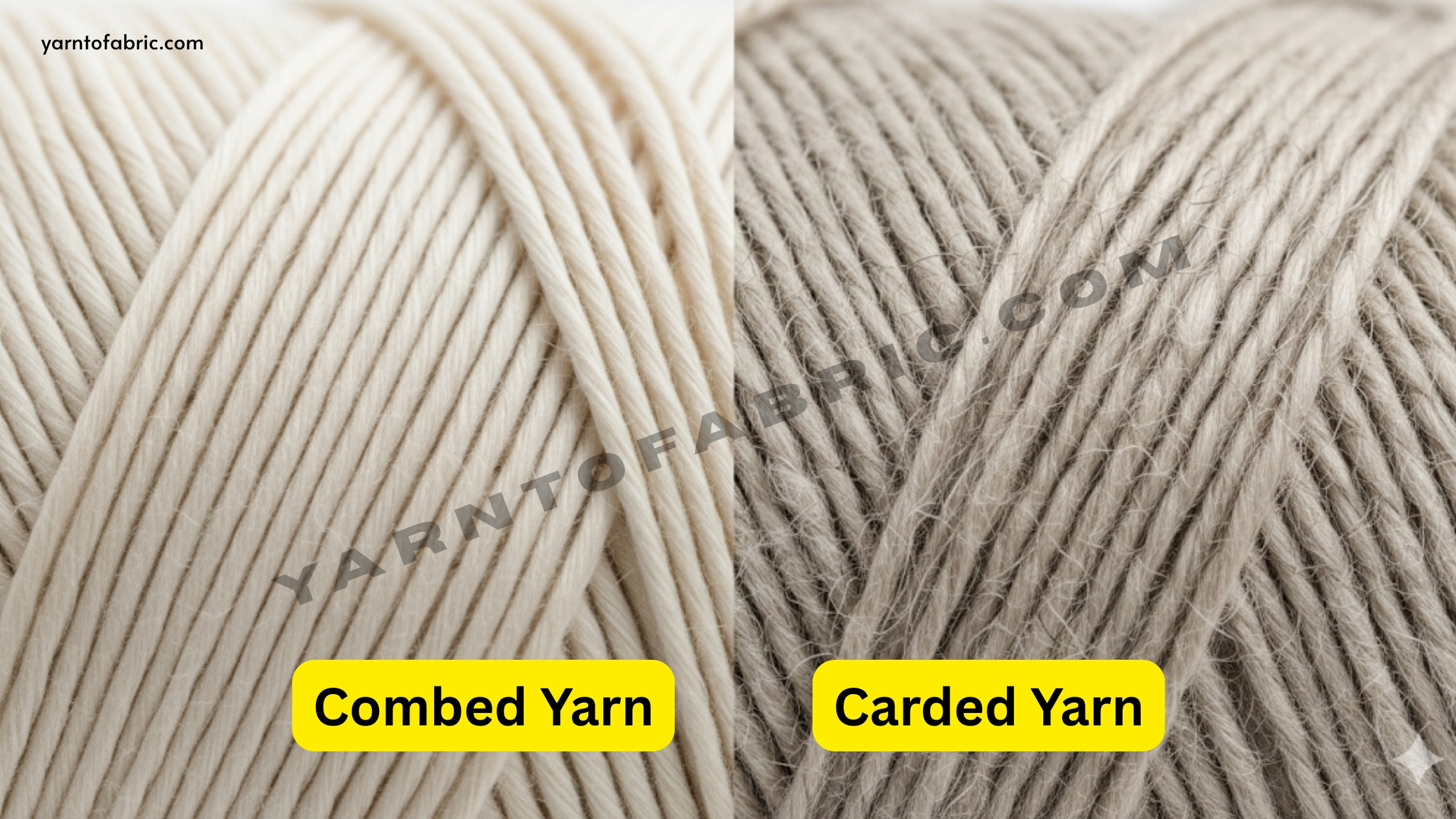
When you buy a piece of clothing, have you ever wondered what makes one T-shirt feel softer than another? Or why one towel is more luxurious and absorbent? The answer often lies in the type of yarn used: carded or combed. These are two different processes used to prepare cotton fibers for spinning, and they result in yarns with very distinct characteristics. Understanding this difference is key for any business in the textile industry, especially in India, where cotton is a major player.
What is Carded Yarn?
Carded yarn is the most basic and common type of cotton yarn. The word “carding” comes from the Latin word for thistle, as thistles were originally used to brush and clean the raw fibers. In modern spinning mills, this process uses a machine with wire teeth to disentangle, clean, and roughly align the cotton fibers into a continuous strand called a “sliver.”
Key Characteristics of Carded Yarn:
- Mixed Fibers: The carding process does not remove the short fibers, so the final yarn contains a mix of both short and long staple fibers.
- Appearance: Because the fibers are not perfectly aligned and some short, stray fibers are present, carded yarn has a slightly rougher, fuzzier, and more natural feel.
- Cost-Effective: The process is faster and less intensive, making carded yarn more economical to produce.
- Durability: It is less strong and more prone to pilling (the formation of small fiber balls on the surface) and breakage compared to combed yarn.
- Ideal for: Everyday use items where cost is a primary concern. Think of casual T-shirts, budget-friendly bedsheets, and durable denim.
What is Combed Yarn?
Combed yarn takes the process a step further. After the cotton fibers are carded, they go through an additional, more refined step called combing. This process uses a specialized machine with fine combs to remove any remaining impurities, neps (small knots of tangled fibers), and, most importantly, all the short fibers. This leaves behind only the longest, straightest, and most uniform fibers.
Key Characteristics of Combed Yarn:
- Long, Uniform Fibers: The process ensures the final yarn consists only of long, high-quality fibers that are perfectly parallel to each other.
- Appearance and Feel: Combed yarn is noticeably smoother, softer, and has a slight luster. The removal of short, loose fibers gives it a much cleaner surface with less hairiness.
- Higher Quality and Strength: The aligned, long fibers create a stronger and more durable yarn. This makes it less prone to pilling and breakage.
- Higher Cost: Since the combing process is time-consuming and generates a significant amount of waste (the discarded short fibers are called “noils”), combed yarn is more expensive than carded yarn.
- Ideal for: Premium products where softness, durability, and a smooth finish are essential. This includes high-end apparel, luxury bed linens, fine towels, and children’s clothing.
Combed vs. Carded: A Simple Comparison
The choice between combed and carded yarn isn’t about one being universally “better” than the other; it’s about matching the right yarn to the right product and price point.
| Feature | Carded Yarn | Combed Yarn |
| Manufacturing | Simpler, faster process. | Additional combing step, more complex. |
| Fiber Length | A mix of short and long fibers. | Only long, uniform fibers. |
| Texture | Coarser, fuzzier, and less even. | Softer, smoother, and more lustrous. |
| Strength | Lower strength, more prone to pilling. | Higher strength and durability, less pilling. |
| Cost | More economical (low to mid-range). | More expensive (premium range). |
| Best For | Everyday wear, affordable clothing, denim. | High-end apparel, luxury home textiles. |