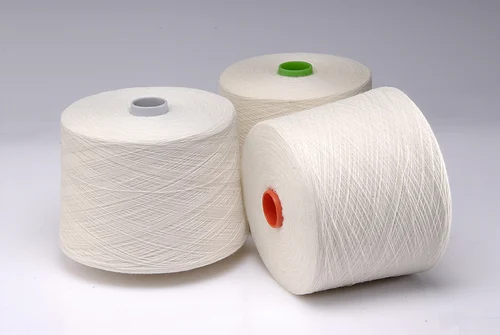
In the world of knitwear—from the everyday T-shirt and fleece hoodies to comfortable innerwear—the yarn of choice often dictates the balance between cost, speed, and final fabric feel. Open-End (OE) yarn, also known as Rotor-Spun yarn, has established itself as a critical player in the knitting sector, primarily due to its high production efficiency and unique structural properties.
Unlike traditional Ring-Spun yarns, which are known for their softness and strength, OE yarn is the workhorse of the industry, particularly for fabrics where bulk, coverage, and affordability are key requirements.
What is Open-End (OE) Yarn?
Open-End spinning is a modern, high-speed technology that creates yarn without the use of a spindle. The process is streamlined and highly automated:
- Direct Feed: Carded cotton sliver is fed directly into the spinning machine, eliminating the intermediate roving stage required by ring spinning.
- Fiber Separation: Inside the machine, a ‘combing roller’ separates the sliver into individual fibers.
- Rotor Mechanism: These individual fibers are introduced into a rapidly rotating rotor (up to 140,000 RPM). Centrifugal force deposits the fibers along the inner groove of the rotor.
- Twist Insertion: The fibers are collected and twisted together as the finished yarn is continuously drawn out of the centre of the rotor and wound onto a large package.
This rapid, continuous process makes OE spinning significantly faster and more cost-effective than ring spinning (often 3-5 times faster).

Why OE Yarn is Preferred for Knitting
The unique structure and manufacturing process of Open-End yarn offer several distinct advantages that make it highly suitable for bulk and mid-range knitwear:
| Advantage for Knitwear | Explanation |
| Cost-Effectiveness | This is the primary driver. The high production speed, fewer process steps (eliminating roving), and high degree of automation drastically reduce labour and power costs per kilogram, making the resulting knitted fabric highly competitive in price. |
| Increased Bulk & Cover | OE yarn has a less parallel arrangement of fibers, giving it a more disorganized and looser structure. This naturally results in a bulkier and thicker yarn for a given count. In knitting, this bulk provides excellent fabric cover, making it ideal for fleece, sweatshirts, and other heavy-gauge knits. |
| Reduced Processing | OE yarn is wound onto large packages (typically 4-5 kg) directly from the spinning machine, eliminating the need for a separate winding process (auto-coning) before knitting. This saves time, reduces material handling, and minimizes yarn joints, leading to smoother knitting efficiency. |
| Abrasion Resistance | The unique way the fibers are bundled, including the “wrapper fibers” on the surface, gives OE yarn excellent resistance to abrasion, making it well-suited for durable items like denim or workwear knits. |
| Sustainability | OE spinning is highly efficient at processing recycled or lower-grade cotton fibers and blends. This makes it a sustainable and economical choice for manufacturers looking to utilise waste cotton (regenerated yarn) without a significant drop in functional quality. |
Structural Differences and Their Impact on Knit Fabric
The difference in spinning mechanism leads to key distinctions in the knitted fabric feel:
| Feature | Open-End (Rotor-Spun) Yarn | Ring-Spun Yarn (For Comparison) |
| Fiber Structure | Core of parallel fibers with outer wrapper fibers. | Parallel and tightly twisted. |
| Texture/Feel | Coarser, drier, and fuzzier hand-feel. | Softer, smoother, and finer feel. |
| Hairiness | Higher (more protruding fiber ends). | Lower (cleaner surface). |
| Strength | Generally 15-20% lower tensile strength. | Higher strength. |
| Pilling | More prone to pilling over time. | Better pilling resistance. |
Because of its relative weakness and higher hairiness, OE yarn is primarily used for medium to coarse counts (up to Ne 30) and is not typically chosen for very fine, high-end knitwear like premium innerwear or delicate knit shirts, where the superior softness and smoothness of ring-spun or compact yarn are required.
Applications in the Knitting Industry
OE yarn dominates the market for a wide range of knitted products:
- Outerwear: Fleece, sweatshirts, hoodies, track pants, and other knitted leisurewear.
- Home Textiles: Blankets, throws, and some types of knit towels that require bulk and absorbency.
- Basics/Workwear: Economical T-shirts, promotional wear, and fabrics requiring high durability and bulk rather than luxury softness.
In conclusion, Open-End yarn is a vital innovation in the textile industry. It provides a powerful combination of speed, bulk, and cost efficiency, making it indispensable for meeting the global demand for affordable, durable knitted garments.